· Glossary · 4 min read
What Is a High-Level Design (HLD)?
High-Level Design (HLD) provides the architectural overview of a system. Learn how HLDs map main components and interactions to guide software development and stakeholder communication.
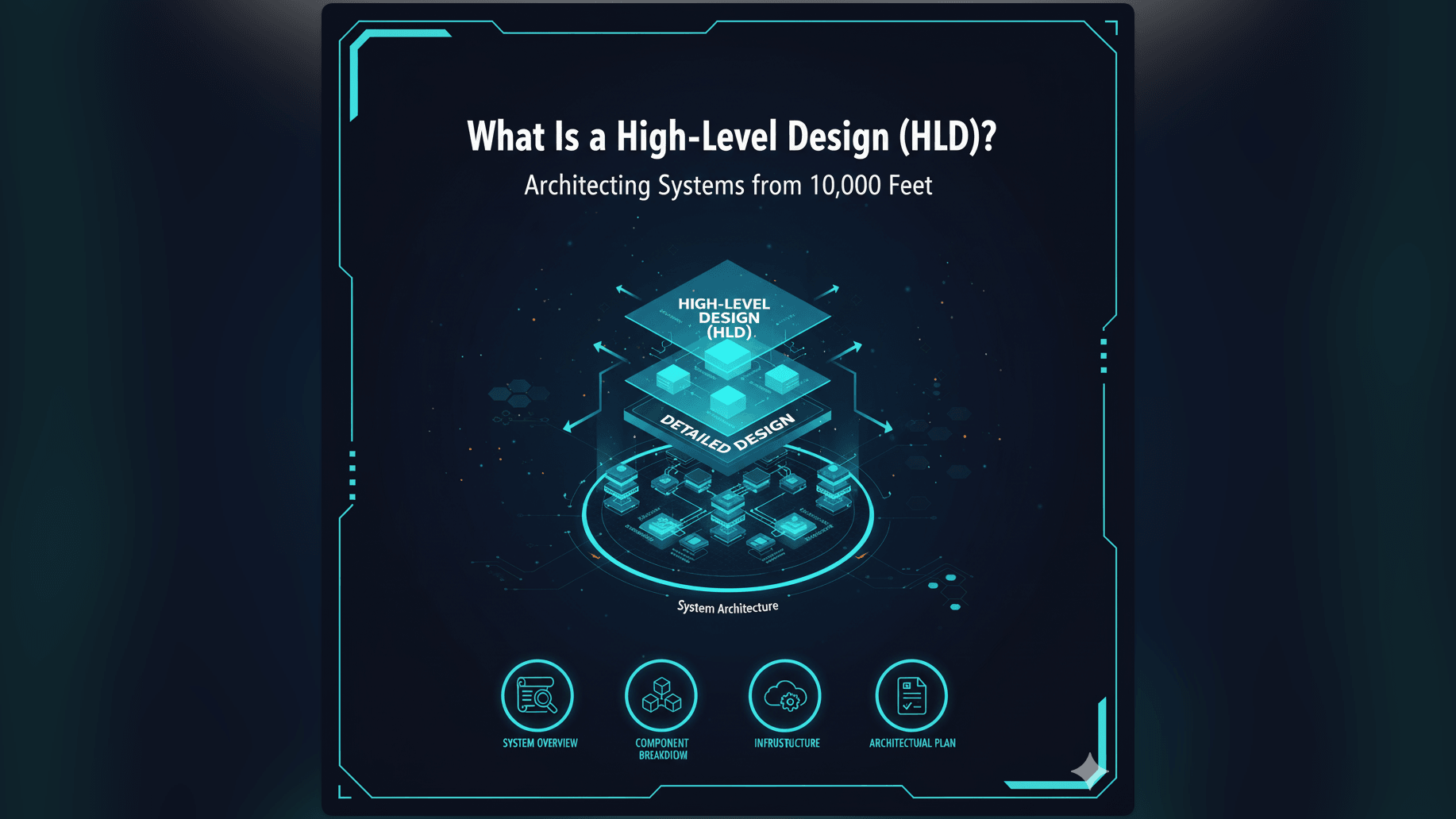
Building software is a lot like constructing a building. You do not start by picking the color of the carpet. You start with the architectural drawings that show where the walls and the foundation go. In software engineering, High-Level Design or HLD is that architectural drawing.
Simple Definition of a High-Level Design
High-Level Design is the architectural overview of a system. It identifies the main components and how they interact with each other without getting into the details of the code. It answers the question “How does this system work?” at a macro level.
If you look at an HLD, you should see boxes representing huge chunks of functionality like “User Database” or “Payment Gateway” or “Mobile App.” You should not see specific class names or function variables. That level of detail belongs in the Low-Level Design (LLD).
An Architectural Overview of a System’s Main Components and Interactions
The HLD is the “30,000-foot view.” It maps out the flow of data across the entire platform. It defines the hardware interfaces, the communication protocols (like HTTP or gRPC), and the major software modules.
It allows an architect to say “The data flows from the Web Server to the Application Server and finally settles in the Database” without needing to explain exactly how the data is formatted.
Why HLDs Are Crucial in the Software Development Lifecycle
Skipping the HLD is a common mistake that leads to “spaghetti architecture.” Without a high-level plan, teams build components that don’t fit together.
Communicating System Structure to Stakeholders and Teams
The HLD is the bridge between the business team and the technical team. A non-technical stakeholder like a CEO or a Project Manager can understand an HLD. They can look at the diagram and understand that the “Reporting Module” is separate from the “Sales Module.” This shared understanding allows for better budget planning and timeline estimation.
Guiding Detailed Design and Implementation Efforts
For the developers, the HLD serves as the roadmap. It defines the boundaries. If the HLD says the “Inventory Service” handles stock logic, then a developer knows not to put that logic in the “Checkout Service.” It keeps the team aligned on the separation of concerns.
Real-World Example: An HLD for a Social Media Platform
Let’s imagine we are designing a competitor to Twitter or X. The HLD document would contain a System Architecture Diagram.
Illustrating Core Modules like User Management, Feed, Messaging
In this diagram, you would see distinct blocks:
- Load Balancer: To distribute traffic.
- User Service: Handling login and profiles.
- Feed Generation Service: Compiling tweets for the timeline.
- Notification Service: Sending push alerts.
- Database Cluster: Storing the data.
The arrows would show that when a user posts a tweet, the traffic hits the Load Balancer, then the Feed Service, and finally the Database. It keeps the logic abstract and easy to digest.
How AI Diagram Maker Supports HLD Creation
Creating these diagrams manually is often the bottleneck in the design phase. Architects spend hours aligning boxes in Visio instead of thinking about the architecture.
Generating System Architecture Diagrams from High-Level Descriptions
With our AI System Architecture Generator, creating an HLD is effortless. You can describe the system in plain English: “Design a microservices architecture for a video app with a content delivery network and a transcoding worker.”
The AI interprets these high-level requirements, selects the appropriate components, and draws the connections. It generates a professional HLD diagram instantly, allowing you to communicate your architectural vision clearly and quickly.
Related Terms
To navigate software architecture, you should know these related terms:
- Low-Level Design (LLD): The detailed phase that follows HLD. It deals with class diagrams, database schemas, and specific algorithms.
- System Architecture Diagram: The visual representation of the HLD showing the physical or logical structure.
- Software Architecture: The fundamental structures of a software system and the discipline of creating them.
- Design Document: A comprehensive file that includes the HLD, LLD, and other planning details for a software project.
- Stakeholder Communication: The practice of explaining technical concepts to non-technical partners often using HLDs as a visual aid.
For more on automating your design documentation, check out our Developer’s Guide to AI Diagramming.